
Screen Enclosure Company Websites: What Actually Books Jobs (A Jacksonville Case Study)
Die Hard Digital LLC — 10+ years in digital marketing, 5+ in construction. 250+ contractor accounts across the US.
Direct answer
A screen enclosure company website earns jobs through three things: a Google Business Profile with the right category and steady job photos, a website with a dedicated page for every service and every city served, and a storm-damage and insurance page that captures the search spike after every Florida hurricane season. The mistake most pool-cage and screen-room contractors make is running a one-page brochure site that can't rank for "pool enclosure [city]" or "screen repair near me" — the exact searches their buyers use.
Screen rooms, pool cages, and lanai enclosures are a strange trade to market. The demand is enormous in Florida, it's intensely local, and half of it is driven by weather nobody can predict. Yet most screen enclosure companies run the same website a plumber down the street uses — a homepage, a services list, a contact form — and then wonder why the phone only rings on referrals.
This guide covers what actually makes a pool enclosure or screen-room website generate booked jobs, the decisions that move rankings for this specific trade, and a concrete example: the full digital foundation we recently built for J-Rod and Sons Screen Rooms in Greater Jacksonville. It's written from 10+ years in digital marketing and 5+ years in construction — not from a template.
Why screen enclosure marketing is its own thing
Screen enclosure work shares one trait with painting: it's a visual sale. A homeowner deciding whether to screen in a lanai or rebuild a storm-torn pool cage wants to see the finished result before they call. Before-and-after photos aren't decoration — they're the sales conversation. But the trade has two characteristics painting doesn't, and they change the whole strategy:
- Demand is weather-driven. Every named storm that crosses Florida produces a wave of "screen enclosure repair near me" and "pool cage rebuild [city]" searches within days. A website built to catch that spike books work while competitors are still answering voicemails.
- The service list is long and specific. New enclosures, rescreens, pool cages, patio covers, retractable screens, tear-outs, storm rebuilds — these are separate searches by separate buyers. Cramming them onto one "Services" page tells Google nothing and ranks for nothing.
Get those two things right and a screen enclosure company can dominate local search in a way most trades can't, because very few enclosure contractors bother to build for it.
What a screen enclosure website actually needs
A screen enclosure website built to rank and convert — not just to exist — needs:
- A page for every service. Screen rooms, pool enclosures, patio and lanai screening, rescreening and repair, storm rebuilds, patio covers, retractable screens. Each one is its own page targeting its own keyword. One page per service is the single biggest structural difference between a site that ranks and a brochure that doesn't.
- A page for every city you serve. A homepage won't rank for "pool enclosure Ponte Vedra" or "screen repair Orange Park." A dedicated city page will. Multiply that across your service area and the coverage compounds fast.
- A real project gallery. Actual jobs — screened pools, finished lanais, before-and-after rescreens — not stock photos of patio furniture. For a visual trade this is the highest-converting element on the site.
- A storm-damage and insurance page. More on this below — it's the piece almost every enclosure contractor leaves on the table.
- Mobile speed. The majority of "screen repair near me" searches happen on a phone, often standing next to the damaged cage. A slow site loses the ranking and the lead.
Our contractor website service builds every one of these pages from the start, structured so authority flows to the pages most likely to earn the searches that produce bookings.
Google Business Profile for enclosure contractors
For most screen enclosure companies, the Google Business Profile drives more calls than the website — it's what powers the Map Pack, the three listings that sit at the top of "pool enclosure company [city]" searches. The elements that move it:
- Primary category: "Screen Enclosure Contractor" where available, not the generic "Contractor." The most specific category wins.
- Service areas: every city and community you cover, listed explicitly.
- Photos, every week: finished enclosures, pool cages, rescreens. Listings with steady recent photo activity outrank dormant ones — and for a visual trade the photos do the selling too.
- Review velocity: a contractor with a dozen recent reviews will often outrank one with fifty from three years ago.
Our local SEO service handles the profile setup and the review system that keeps that velocity up without it feeling automated.
The storm-damage advantage most contractors miss
This is the one that separates a screen enclosure company that grows from one that waits for the phone to ring. After every major storm, Florida homeowners search for help with torn screens, collapsed pool cages, and bent frames — and a large share of that work is covered by insurance. The searches are urgent, high-intent, and low-competition, because most enclosure contractors have nothing on their site that matches them.
A dedicated storm-damage page — one that explains the rebuild process, mentions insurance documentation, and ranks for "screen enclosure storm damage [city]" — captures buyers at the exact moment they need to hire and are least price-sensitive. Pair it with a Google Business Profile that's already established, and a well-built enclosure site can pull in storm work for weeks after a system passes through.
What we built for J-Rod and Sons
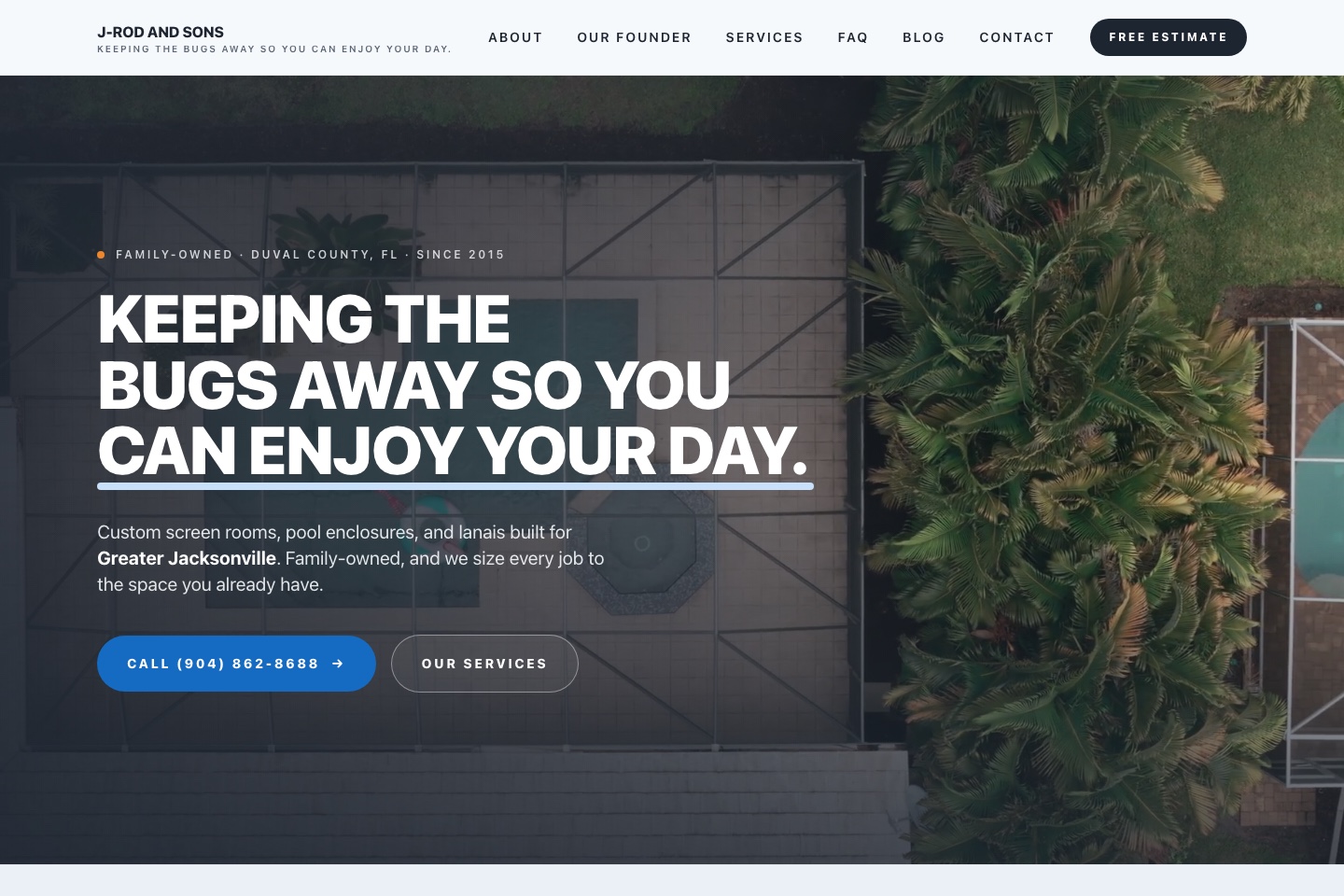
J-Rod and Sons Screen Rooms is a family-owned screen enclosure builder in Greater Jacksonville, founded in 2015 by Jerrold Mills Sr. Their old site was gone and out of their control, so we rebuilt the whole digital foundation from scratch. A few of the choices worth highlighting, because they apply to every screen enclosure contractor:
Nine service pages, not one list. Screen rooms, pool enclosures, patio and lanai screening, rescreening and repair, storm rebuilds, patio covers, retractable screens, screen walls, and tear-outs each got a dedicated page — every one a separate entry point from search.
A service-by-city page for every combination. Each service is built out across every community they cover — Jacksonville, Orange Park, St. Augustine, Ponte Vedra, Fleming Island, Nocatee, and more — so the site has a real page to rank for "pool enclosure Nocatee" instead of hoping the homepage does it.
A storm-damage and repair track. The rescreen and storm-rebuild pages speak directly to insurance-driven buyers, with before-and-after sliders showing torn-to-finished work — the visual proof that closes this trade.
An aerial video hero. The homepage opens on a drone shot of a finished screened pool enclosure — the product, at scale, in the first two seconds. For a visual trade, that beats any headline.
FAQ content and structured data throughout. Every service page answers the questions homeowners actually ask, marked up so Google can surface them directly — the kind of structure that increasingly earns visibility in AI answers, not just blue links.
We don't have ranking data to share yet — the site launched recently — but the foundation is built to compound: dozens of service and city pages indexed, a profile set up to grow, and a content structure ready for the next storm season.
Why voice mattered more than the service list
Jacksonville has no shortage of screen enclosure contractors. What sets J-Rod apart isn't a service nobody else offers — it's how they operate, and the site says it plainly: the owner quotes the job, the owner runs the job, and the owner walks the finished work with you at the end. Every build carries a 10-year workmanship warranty. That's specific, verifiable, and rare, so we put it front and center instead of burying it under "professional and reliable."
That's the part a template can't do. The page structure gets you found; the voice is what turns a visitor into a phone call. For a family business competing on trust rather than price, saying the true, specific thing out loud converts better than any stock reassurance ever will.
When a new website isn't the first move
If you have no photos of your work. A screen enclosure site with stock imagery underperforms, full stop. Spend two weeks photographing finished jobs before investing in the site — the portfolio is the product.
If you need work this month. SEO takes 3–6 months to move. If you're slow right now, Google Ads produce calls within days while the organic foundation builds underneath.
If your Google rating is below 4.0. Driving traffic to a listing that converts poorly wastes the investment. Fix the review problem first — it's faster and cheaper than SEO and makes everything else work better.
Not sure which situation you're in? A free audit tells you exactly where the gap is and whether a new site is the right first move or whether something should come before it.
FAQ
What does a screen enclosure company website need to rank on Google?
A dedicated page for every service (screen rooms, pool enclosures, rescreening, storm rebuilds, patio covers), a page for every city you serve, a real project gallery, a storm-damage and insurance page, and fast mobile load times. A one-page brochure site can't rank for the service-plus-city searches enclosure buyers actually use.
Why is a storm-damage page so important for pool cage contractors in Florida?
Every major Florida storm produces a spike in urgent, insurance-driven searches for screen and pool cage repair. A dedicated storm-damage page that explains the rebuild and insurance process captures those high-intent buyers at the moment they need to hire — and most enclosure contractors have nothing on their site that matches those searches.
How important are photos for a screen enclosure business?
Critical. Screen enclosure work is a visual sale — homeowners want to see finished pools, lanais, and before-and-after rescreens before they call. Real job photos on your Google Business Profile and website both improve rankings and do the selling before the first conversation.
How long before a new screen enclosure website generates leads?
Google Business Profile and Map Pack movement can start within 6–12 weeks of proper setup. Organic rankings for competitive service-and-city keywords typically take 3–6 months. If you need work sooner, Google Ads produce calls within days while the organic foundation builds.
What did Die Hard Digital build for J-Rod and Sons Screen Rooms?
We rebuilt the full digital foundation for J-Rod and Sons in Greater Jacksonville — brand voice, a homepage with an aerial video of a finished enclosure, nine dedicated service pages, service-by-city pages across their whole coverage area, storm-damage and repair pages with before-and-after sliders, and FAQ content with structured data throughout. The site launched recently, so ranking data isn't available yet, but the structure is built to compound.
Die Hard Digital builds websites, SEO, and lead systems for contractors and trades — including screen enclosure and pool cage companies. 250+ accounts across the US. No long contracts.
A free audit covers your Google Business Profile, current rankings, and site speed — and tells you the fastest path to more booked jobs.
Find out what'scosting you jobs.
A free audit covers your Google rankings, Google Business Profile, site speed, and ad spend. You'll know exactly what's broken before we talk about fixing it.